Tabriz vs Kashan: Comparing Two Persian Masterpiece Traditions
In the world of Persian carpets, few names carry as much weight as Tabriz and Kashan. Both cities have centuries of weaving heritage, both produce carpets of remarkable beauty and craftsmanship, and both are staples of serious collections worldwide. Yet their carpets are distinctly different in character — and understanding those differences is key to choosing the right one for your home.
Tabriz: The Cosmopolitan Weaver
Tabriz, the capital of East Azerbaijan province in northwestern Iran, is one of the oldest and most important carpet-weaving centers in the world. Its weaving tradition dates back to at least the 15th century Safavid era, and the city experienced a major revival in the 19th century that established its modern reputation.
**Design Philosophy.** Tabriz carpets are celebrated for their extraordinary range. Unlike some weaving centers that specialize in a narrow design vocabulary, Tabriz weavers have historically been willing to draw from multiple traditions and innovate freely. You will find Tabriz carpets with classical medallion-and-corner layouts, all-over floral patterns, pictorial scenes, hunting motifs, and even geometric tribal-inspired designs.
This versatility is partly because Tabriz has long been a commercial crossroads, exposed to influences from Turkey, the Caucasus, Central Asia, and Europe. Tabriz weavers have always been pragmatic: they study the market, adapt their designs, and produce what discerning buyers want. This is not a criticism — it is a strength. Tabriz produces some of the most refined and carefully designed carpets in the world.
**Weaving Technique.** Tabriz carpets use a distinctive hook tool called a "tij" that allows weavers to work quickly while maintaining precision. The Turkish (symmetrical) knot is traditional in Tabriz, though some modern workshops use the Persian (asymmetrical) knot. Knot densities range widely, from moderate commercial-grade pieces (around 100-200 knots per square centimeter) to masterwork pieces exceeding 500 knots per square centimeter.
**Materials.** High-quality Tabriz carpets typically use fine wool pile on a cotton foundation. Many incorporate silk highlights in the design — silk-accented medallions, floral details, and borders are a hallmark of better Tabriz work. Pure silk Tabriz carpets exist but are less common than Ghom silk.
**Color Palette.** Tabriz carpets tend toward refined, harmonious color palettes. Ivory, cream, and soft blue backgrounds are common, often paired with rose, salmon, green, and gold accents. The overall effect is elegant and restrained — Tabriz carpets rarely shout. They integrate beautifully into both traditional and contemporary interiors.
**Signature Design.** The classic Tabriz design is the "Mahi" (fish) pattern — an allover herati pattern of small fish-like motifs arranged around diamond shapes. Tabriz Mahi carpets are among the most recognized Persian carpet designs in the world.
Kashan: The Classical Purist
Kashan, located in Isfahan province in central Iran, has an equally distinguished pedigree. Historical evidence suggests that some of the greatest Safavid-era court carpets were woven in Kashan, and the city's modern weaving tradition, revived in the late 19th century, remains among the finest in Iran.
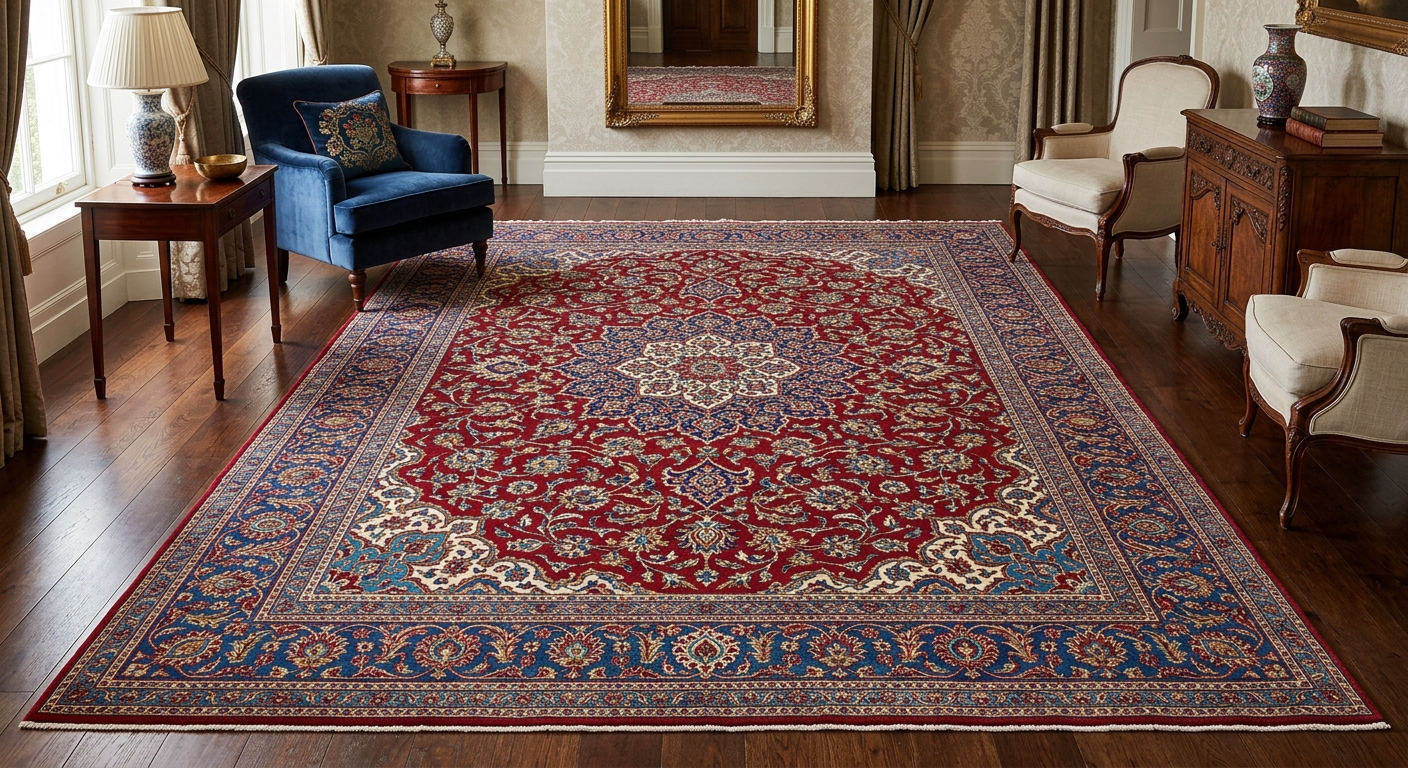
**Design Philosophy.** Where Tabriz is cosmopolitan and varied, Kashan is classical and focused. Kashan weavers have refined a relatively narrow set of designs to near perfection. The typical Kashan carpet features a central medallion — often a complex, lobed form — set against a field of intricate arabesques and floral scrollwork, framed by elaborate borders.
This is not to say Kashan carpets are repetitive. Within that classical framework, there is extraordinary variation in detail, proportion, and color. But Kashan is fundamentally a traditionalist — its weavers are conservators of a classical ideal rather than innovators.
**Weaving Technique.** Kashan weavers use the Persian (asymmetrical) knot, which allows for more fluid, curvilinear designs. The weave is typically very tight and regular, producing a crisp, precise surface. Knot densities in quality Kashan carpets generally fall between 200 and 400 knots per square centimeter, with exceptional pieces going higher.
**Materials.** Traditional Kashan carpets use high-quality Manchester wool (so named because it was originally imported through Manchester, England) on a cotton foundation. The wool is known for its softness and luster. Silk Kashan carpets are produced but are less well-known than Ghom silk.
**Color Palette.** Kashan is famous for its rich, warm color palettes. Deep red (often described as "Kashan red") is the signature background color, though navy blue and ivory grounds are also produced. The accent colors — cobalt blue, emerald green, gold, and cream — create a sumptuous, jewel-toned effect.
**Signature Design.** The quintessential Kashan design is the "Shah Abbasi" pattern, featuring large palmette motifs derived from the courtly designs of the Safavid Shah Abbas era. These palmettes, combined with scrolling vines and intricate corner pieces, create a carpet of regal beauty.
Head-to-Head Comparison
**Versatility.** Tabriz wins here. Its broader design range means you can find a Tabriz carpet for virtually any interior style, from a classical drawing room to a minimalist modern apartment. Kashan's more focused classical vocabulary works best in traditional or transitional settings.
**Detail and Precision.** Both cities produce exceptionally fine work. At the highest levels, Tabriz and Kashan are roughly comparable in knot density and technical execution. However, Kashan's more standardized approach means quality tends to be more consistent across the range, while Tabriz's output varies more widely from workshop to workshop.
**Color.** This is a matter of taste. Tabriz's softer, more neutral palettes appeal to buyers furnishing modern or transitional spaces. Kashan's richer, warmer tones are perfect for those who want their carpet to make a bold statement.
**Durability.** Both are excellent. High-quality carpets from either city will last generations with proper care. Tabriz carpets with silk highlights require slightly more care than all-wool Kashan pieces, but the difference is marginal.
**Investment Value.** Both Tabriz and Kashan carpets hold their value well. Fine examples from either city are sought after by collectors worldwide. Tabriz's broader market appeal can make it slightly easier to resell, while exceptional Kashan pieces with provenance can command premium prices at auction.
**Price Range.** Both cities produce carpets across a wide price spectrum. At the entry level, Kashan tends to be slightly more accessible. At the premium end, exceptional Tabriz and Kashan pieces command comparable prices, though truly extraordinary Tabriz silk-accented pieces can reach the highest tiers.
Which Should You Choose?
If you are furnishing a modern or contemporary space and want a carpet that integrates harmoniously with neutral tones and clean lines, a Tabriz carpet — particularly one with an ivory or soft blue ground — is likely the better choice.
If you want a carpet that commands attention with rich, warm colors and unmistakably classical Persian design, a Kashan carpet will deliver that presence with authority.
If you value versatility and want the widest range of design options, Tabriz offers more variety.
If you value consistency and want the assurance of a focused, refined tradition, Kashan's disciplined approach is appealing.
Ultimately, both Tabriz and Kashan represent the very best of Persian carpet weaving. You cannot go wrong with either. The choice comes down to your personal aesthetic and the character of the space you are furnishing.
At Carpet Maison, we carry a curated selection of both Tabriz and Kashan carpets, each one photographed in detail so you can appreciate the design, color, and craftsmanship before making your decision. We invite you to explore both collections and discover which tradition speaks to you.