
Understanding Persian Carpet Materials: Wool vs Silk vs Viscose
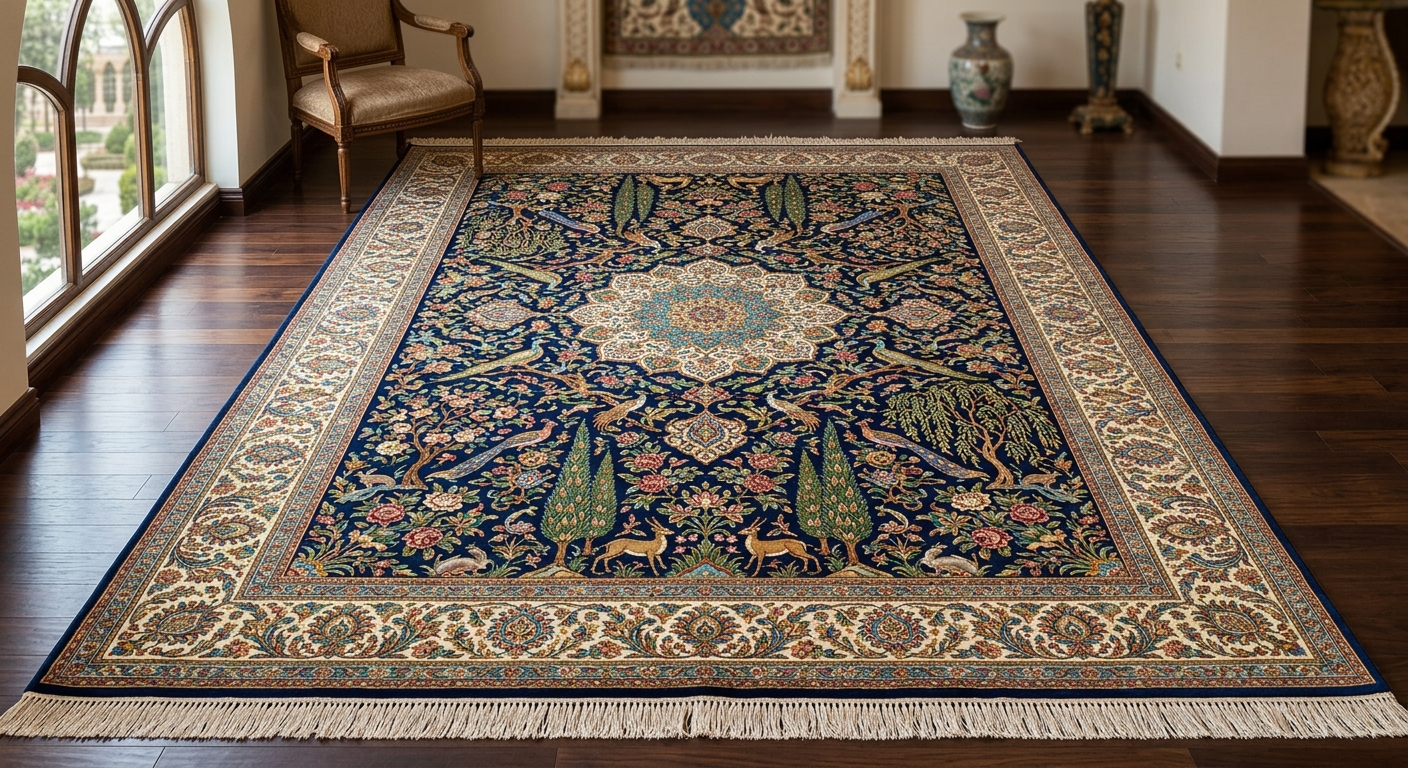
When choosing a Persian carpet, one of the most important decisions you will make is the material. Wool, silk, and viscose each offer a fundamentally different experience — in how the carpet looks, how it feels, how long it lasts, and how much it costs. Understanding these differences is essential to making a choice you will be happy with for years to come.
Wool: The Timeless Workhorse
Wool is the foundation material of Persian carpet weaving and has been for thousands of years. The vast majority of antique and traditional Persian carpets are made from hand-spun wool, and for good reason: it is remarkably versatile.
**Durability.** Wool fibers are naturally resilient. They can be bent back on themselves thousands of times without breaking, which is why wool carpets can endure decades — even centuries — of foot traffic. A well-made wool carpet in a residential setting will easily last 50 to 100 years with proper care.
**Texture and Feel.** Wool has a warm, substantial feel underfoot. It is neither too soft nor too stiff, offering a satisfying balance that makes it comfortable in living rooms, bedrooms, and dining areas alike. Over time, wool develops a soft patina that actually enhances its beauty — a quality collectors refer to as "aging gracefully."
**Stain Resistance.** Wool fibers have a natural lanolin coating that repels liquids. Spills tend to bead on the surface rather than soaking in immediately, giving you time to blot them away. This makes wool the most practical choice for busy households, especially those with children.
**Color.** Wool takes natural and synthetic dyes beautifully, producing deep, saturated colors that remain vibrant over time. The slight natural variation in hand-spun wool creates an organic warmth that machine-spun fibers cannot replicate.
**Price.** Among handmade options, wool is generally the most accessible. Prices vary based on knot density, origin, and design complexity, but wool carpets offer the best value for everyday use.
**Best For.** Living rooms, dining rooms, hallways, bedrooms — essentially any room in the house. Wool is the default choice for most buyers, and for good reason.
Silk: The Pinnacle of Luxury
If wool is the workhorse, silk is the show horse. Silk Persian carpets represent the absolute pinnacle of the weaving art, and their beauty is genuinely breathtaking.
**Detail and Design.** Silk fibers are much finer than wool, allowing weavers to achieve extraordinarily high knot densities — sometimes exceeding 1,000 knots per square centimeter. This enables designs of almost photographic detail. The finest silk carpets from Ghom and Isfahan feature intricate floral patterns, hunting scenes, or geometric motifs that rival fine painting in their precision.
**Luster.** Silk has a natural sheen that gives carpets a luminous quality, almost as if they are lit from within. This luster shifts with the angle of light and the direction you view the carpet, creating a dynamic visual experience that changes throughout the day.
**Texture.** Silk feels cool, smooth, and exceptionally soft to the touch. Walking barefoot on a silk carpet is a tactile luxury that wool simply cannot match.
**Durability.** This is where silk's limitations emerge. Silk is significantly less durable than wool. It is more susceptible to wear, staining, and sun damage. Silk carpets are not recommended for high-traffic areas or homes with young children and pets. They are best placed in formal sitting rooms, bedrooms, or displayed on walls.
**Price.** Silk carpets are substantially more expensive than their wool equivalents, often by a factor of three to ten. A fine Ghom silk carpet is a significant investment, but it is also a genuine work of art with potential to appreciate in value.
**Care.** Silk requires professional cleaning — never use household carpet cleaners or steam on silk. It should be kept out of direct sunlight to prevent fading and fiber degradation.
**Best For.** Formal rooms, bedrooms with minimal foot traffic, and wall display. Silk carpets are ideal for collectors and those who appreciate fine craftsmanship above all else.
Wool-Silk Blends: The Best of Both Worlds
Many Persian carpets combine a wool pile with silk highlights. This is particularly common in higher-quality Tabriz and Kashan carpets, where silk is used to accentuate certain design elements — a central medallion, floral details, or border motifs.
The result is a carpet with the durability and practicality of wool, enhanced by the subtle luster and refined detail of silk accents. These blends offer an appealing middle ground for buyers who want a touch of luxury without the fragility of pure silk.
Some carpets use a silk foundation (warp and weft) with a wool pile. This allows for a finer weave structure and higher knot density than an all-wool carpet, while maintaining the pile durability of wool.
**Best For.** Living rooms and dining rooms where you want elevated elegance with practical durability.
Viscose: The Accessible Alternative
Viscose (also marketed as "art silk" or "bamboo silk") is a semi-synthetic fiber derived from wood pulp, most often from bamboo or eucalyptus. It is designed to mimic the sheen and softness of silk at a fraction of the cost.
**Appearance.** Fresh out of the shop, a high-quality viscose carpet can look remarkably similar to silk. It has a bright, attractive luster and a soft hand feel that appeals to many buyers.
**Durability.** This is viscose's major weakness. Viscose fibers are much weaker than wool or even silk, particularly when wet. Viscose carpets are prone to crushing (pile flattening), matting, and water damage. They do not recover well from heavy foot traffic and tend to show wear patterns relatively quickly.
**Stain Resistance.** Viscose is highly absorbent and stains easily. Water itself can leave marks on viscose, and professional cleaning is difficult because the fibers weaken when wet. This makes viscose problematic for homes with pets, children, or high traffic.
**Price.** Viscose's main advantage is affordability. It allows manufacturers to produce carpets with a silk-like appearance at a significantly lower price point. For decorative use in low-traffic areas, this can be a reasonable trade-off.
**Lifespan.** Expect a viscose carpet to last 3 to 7 years with careful use, compared to 50+ years for quality wool. When evaluating the cost-per-year, viscose is often not the bargain it initially appears.
**Best For.** Decorative accents in low-traffic rooms, or as a temporary solution while saving for a handmade wool or silk carpet.
Cotton and Other Foundation Materials
While not a pile material, cotton is widely used in the foundation (warp and weft) of Persian carpets. A cotton foundation provides excellent stability and lies flat, which is why it is preferred for city-woven carpets from Tabriz, Kashan, and Isfahan.
Nomadic and tribal carpets, including Gabbeh and some Kurdish designs, often use a wool foundation. This makes them more flexible and slightly less uniform, contributing to their rustic character.
How to Identify Materials
When shopping for a Persian carpet, knowing how to identify materials is valuable:
**The burn test** (when permitted) is the most reliable method. Wool and silk both smell like burning hair, but silk burns more slowly and leaves a fine, powdery ash. Viscose smells like burning paper and leaves a hard, dark residue.
**Visual inspection.** Silk has a more consistent, brighter luster than viscose. Hold the carpet at an angle — silk will show a rich, deep sheen that changes direction, while viscose tends to have a flatter, more uniform shine.
**Touch.** Silk feels cool and smooth, almost slippery. Wool feels warm and springy. Viscose feels soft but somewhat papery when dry.
**Knot density.** Extremely high knot counts (above 500 knots per square centimeter) almost always indicate silk, as wool fibers are too thick to achieve that density.
Making Your Choice
For most buyers, the decision comes down to intended use:
If you want a carpet for daily life — one that will handle foot traffic, occasional spills, and the general wear of a family home — **wool is the clear winner**. It is durable, beautiful, and ages gracefully.
If you are furnishing a formal space or seeking a collector's piece that showcases the highest level of weaving artistry, **silk is unmatched** in its beauty and detail.
If budget is your primary constraint and you need a decorative carpet for a low-traffic space, **viscose can serve as a stopgap**, though we recommend saving for wool when possible.
At Carpet Maison, we clearly label the material composition of every carpet in our collection, so you always know exactly what you are buying. Browse our selection to see the full range of materials and find the perfect match for your home.