
The Art of Persian Carpet Weaving: A 2,500-Year Heritage
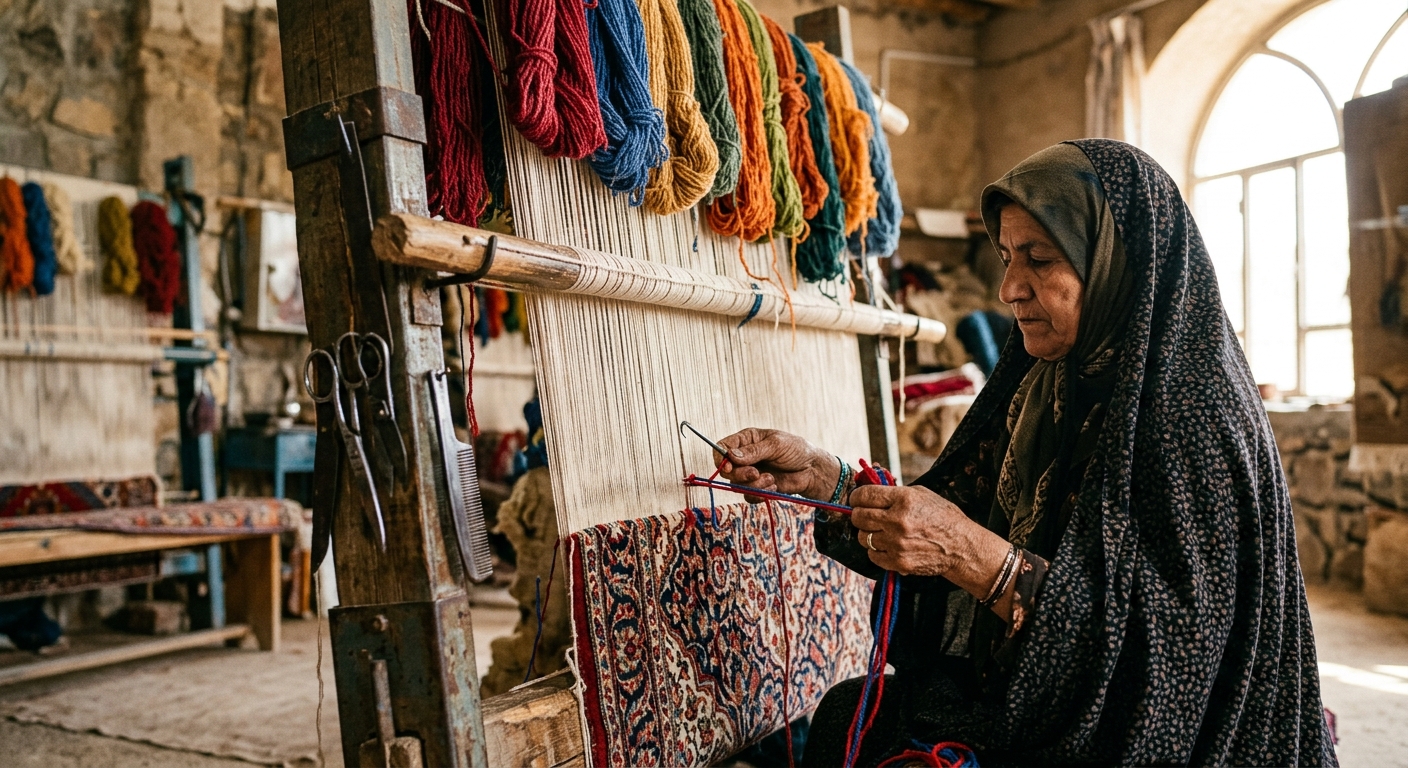
Few art forms can claim a continuous history spanning two and a half millennia. Persian carpet weaving is one of them. From the frozen tombs of Siberia to the palaces of Renaissance Europe, from the bazaars of Isfahan to the living rooms of modern homes worldwide, Persian carpets have been objects of beauty, symbols of status, and carriers of cultural identity for over 2,500 years.
The Oldest Known Carpet
The story begins with the Pazyryk carpet, discovered in 1949 by Russian archaeologist Sergei Rudenko in a frozen Scythian burial mound in the Altai Mountains of Siberia. Radiocarbon dating places it around 500 BCE, making it the oldest known surviving pile carpet in the world.
The Pazyryk carpet is remarkably sophisticated for its age. Measuring roughly 1.8 by 2 meters, it features an intricate design of horsemen, deer, and griffins arranged in concentric borders around a central field of geometric motifs. The knot density — approximately 36 knots per square centimeter — indicates a mature weaving tradition that was already centuries old when this carpet was made.
Most scholars believe the Pazyryk carpet was woven in Persia (modern Iran) during the Achaemenid Empire, the first great Persian dynasty. If so, it means Persian carpet weaving was already a highly developed art form five centuries before the Common Era.
The Sasanian and Early Islamic Period
During the Sasanian dynasty (224-651 CE), carpet weaving reached new heights of luxury. Historical accounts describe the legendary "Spring of Khosrow," a massive carpet reportedly measuring over 100 feet square that adorned the royal palace at Ctesiphon. Made of silk, gold thread, and precious stones, it depicted a paradise garden with streams, trees, and flowers — a design concept that would influence Persian carpet patterns for centuries to come.
When Arab armies conquered the Sasanian Empire in the 7th century, they were so impressed by this carpet that it was sent to the caliph in Medina as war plunder. Unfortunately, it was cut into pieces and distributed among the soldiers, and no fragment survives. But its legend endured, and the paradise garden motif — with its four-part division representing the four rivers of paradise — remains a foundational element of Persian carpet design to this day.
The Islamic conquest did not end Persian weaving; it transformed it. Islamic prohibitions on figurative representation encouraged the development of geometric and arabesque patterns that became defining features of Persian carpet art. At the same time, human and animal motifs never disappeared entirely from Persian carpets, distinguishing them from their Arab and Turkish counterparts.
The Golden Age: Safavid Dynasty
The Safavid dynasty (1501-1722) represents the golden age of Persian carpet weaving. Under the patronage of Shah Tahmasp I and Shah Abbas I, carpet weaving was elevated from a cottage industry to a royal art form.
Shah Abbas I (r. 1588-1629) established royal workshops in Isfahan, Kashan, Kerman, and Tabriz, staffing them with master weavers and court designers. These workshops produced carpets of unprecedented refinement — silk and wool masterpieces with knot counts reaching 700 or more per square centimeter, featuring elaborate medallion designs, hunting scenes, and garden motifs.
The Safavid period gave us many of the design vocabularies we still associate with Persian carpets. The Shah Abbasi palmette motif, the herati "fish" pattern, the boteh (paisley), and the central medallion with corner spandrels — all were refined or codified during this extraordinary period.
Safavid carpets also became major trade goods. European merchants — particularly Venetians, Dutch, and English — imported Persian carpets in large quantities. They appear in paintings by Holbein, Lotto, Memling, and Vermeer, and European courts competed to acquire the finest examples. This trade established Persian carpets as a global luxury commodity, a status they have never lost.
The Decline and Revival
The fall of the Safavid dynasty in 1722, followed by decades of political instability, disrupted the royal workshops and led to a decline in quality. The Qajar dynasty (1789-1925) saw a gradual recovery, driven largely by growing European demand.
The great revival came in the mid-to-late 19th century, when European and American trading companies established buying networks across Iran. Cities like Tabriz, Kashan, Kerman, and Mashhad became major export centers. The merchants brought standardized quality controls and introduced chemical dyes alongside traditional vegetable dyes.
This period was a double-edged sword. On one hand, it revitalized the industry and brought employment to thousands of families. On the other, the pressure of commercial production sometimes came at the expense of artistic freedom. The finest modern carpets still aspire to the standards of the Safavid golden age, while the commercial market has expanded to include a wider range of qualities and price points.
Regional Traditions
One of the great richnesses of Persian carpet weaving is its regional diversity. Different cities, villages, and tribal groups have developed distinct styles over centuries:
**Tabriz**, in northwestern Iran, is perhaps the most versatile weaving center. Known for its refined designs and technical precision, Tabriz produces everything from classical medallion carpets to pictorial scenes and modern interpretations.
**Isfahan** is famous for some of the finest weaving in the world. Isfahan carpets often use silk on a silk foundation with extraordinarily high knot densities, producing designs of almost jewel-like precision.
**Kashan** maintains a proud tradition of classical elegance, with rich red and blue palettes and Shah Abbasi-derived designs that represent the archetype of "what a Persian carpet looks like" in many people's minds.
**Ghom** (Qom) is the silk carpet capital of Iran. Founded as a weaving center only in the 20th century, Ghom rapidly became renowned for pure silk carpets of exceptional quality, often featuring intricate medallion and garden designs.
**Gabbeh** carpets, woven by the Qashqai and Luri nomads of southern Iran, represent a completely different aesthetic. Their bold, minimal designs — often depicting simple geometric forms, animals, or landscapes in vivid primary colors — have found enthusiastic admirers in the contemporary design world.
**Kerman** carpets are known for their elaborate all-over floral designs, soft wool, and pastel color palettes that have made them particularly popular in Western interiors.
The Weaving Process
A handmade Persian carpet is created entirely by human hands, without powered machinery. The process has changed remarkably little over the centuries.
The foundation consists of warp threads (usually cotton or silk) stretched vertically on a loom, with weft threads woven horizontally between rows of knots. Each knot is tied individually by hand — a single carpet may contain millions of knots.
Two main knot types are used: the Turkish (Ghiordes or symmetrical) knot, common in Tabriz and tribal weaving, and the Persian (Senneh or asymmetrical) knot, used in Kashan, Isfahan, and most other city workshops. The Persian knot allows for slightly finer detail, but both types can produce carpets of extraordinary quality.
A skilled weaver can tie between 8,000 and 12,000 knots per day. At that rate, a large carpet with 300 knots per square centimeter might take two or three years to complete. The finest silk carpets can take even longer.
Persian Carpets Today
The Persian carpet industry faces both challenges and opportunities in the 21st century. Economic sanctions, competition from machine-made and imported carpets, and changing consumer tastes have all put pressure on traditional weavers. The number of active looms in Iran has declined significantly over recent decades.
Yet the finest workshops continue to produce work of extraordinary quality. A growing appreciation for handmade craftsmanship, sustainability, and authentic cultural objects has created new demand among discerning buyers worldwide. Museums continue to collect Persian carpets, auction records are regularly broken, and interior designers increasingly specify handmade Persian carpets as statement pieces in high-end projects.
The art of Persian carpet weaving was inscribed on the UNESCO Intangible Cultural Heritage of Humanity list in 2010, recognizing its significance as a living tradition that connects present-day artisans to 2,500 years of continuous creative practice.
Why It Matters
When you bring a Persian carpet into your home, you are not just acquiring a beautiful object. You are participating in one of the longest-running artistic traditions in human history. Every knot was tied by human hands, using techniques developed and refined over millennia. The designs carry echoes of Achaemenid gardens, Sasanian courts, Safavid royal workshops, and the bold creativity of nomadic tribes.
At Carpet Maison, we believe that understanding this heritage deepens the appreciation of every carpet in our collection. Each piece carries within it a story of craft, culture, and continuity that spans thousands of years.